






In São Carlos, Brazil—a city with one of the highest concentrations of Ph.D. holders in Latin America—scientific discovery looks a bit different. Step into building Q17 at the University of São Paulo's Institute of Chemistry (IQSC-USP), and you will not find bubbling flasks. Instead, you will see an advanced laboratory with twenty-five modest desks, each equipped with dual monitors flashing lines of Python code and molecular structures.
This is the home of the Quantum Theory of Nanomaterials (QTNano) group.
Our journey began in August 2009. Armed with a FAPESP Young Researcher grant, we set out to study computational catalysis. In those early days, space was so restricted that we shared a single small office—a logistical challenge that forged our tight-knit, collaborative spirit. Through distinct phases of institutional growth, that single room transformed into a research hub. Today, we lead the Computational Materials Design program within the Center for Innovation on New Energies (CINE), supported by a landmark decade-long partnership with FAPESP and Shell Petroleum Brazil.
We do not mix physical chemicals. Instead, we use quantum mechanics, Density Functional Theory, and Molecular Dynamics to simulate atomic behavior. By modeling metallic surfaces and nanoparticles on computers, we predict material performance to accelerate the transition to clean energy.
What truly defines us is our mindset. We treat computational setbacks not as personal failures, but as essential data points that narrow our path to discovery. This resilience unites our multicultural team, which brings together researchers from Brazil, Mexico, India, Pakistan, and Iran. Working entirely in English, we cross cultural boundaries daily, share code, and write our own textbooks to preserve group knowledge.
We believe the future is shaped by concrete actions, not just intentions. Whether we are optimizing cluster workflows or sharing our discoveries with our 31,000 LinkedIn followers (2026), we bridge the gap between quantum science and society. Welcome to QTNano.

For over three decades, Juarez L. F. Da Silva has been driven by a singular, powerful pursuit: understanding the fundamental building blocks of matter to design the technologies of tomorrow. Today, as an Associate Professor at the Institute of Chemistry of São Carlos (IQSC), University of São Paulo (USP), he leads pioneering research at the intersection of chemistry, physics, and computational science.
Here is a look at the journey, the science, and the leadership behind his work.
A Global Scientific Odyssey: Before anchoring his research group in São Carlos, Prof. Da Silva spent 11 years working at some of the world’s most prestigious scientific international institutions.
His journey began in Brazil, where he earned his Bachelor’s degree in Physics from the Federal University of Goiás and a Master’s degree from the Institute of Physics at USP. Drawn to the vanguard of computational materials science, he moved to Germany, completing his PhD in Natural Sciences through a joint initiative between the Technical University of Berlin and the Fritz- Haber Institute of the Max-Planck Society—a global epicenter for surface science.
His international career spanned roles as a postdoctoral researcher at the Juelich Research Center and Humboldt University in Germany, followed by three years as an Associate Researcher at the National Renewable Energy Laboratory (NREL) in Golden, Colorado. This global perspective deeply informs his collaborative approach to science today.
Designing Materials at the Atomic Level: In 2009, Prof. Da Silva returned to Brazil, bringing home a wealth of international expertise. In 2012, he joined the IQSC-USP as faculty member and in 2014, he founded the Quantum Theory of Nanomaterials (QTNano) group in São Carlos, creating a hub for cutting-edge computational chemistry.
Rather than mixing chemicals in a traditional wet lab, his team uses advanced computer algorithms and quantum mechanics—specifically Density Functional Theory and Molecular Dynamics—to simulate how atoms behave. By modeling metallic surfaces, nanoparticles, and semiconductors on a computer, they can predict how materials will perform before they are ever manufactured in a physical lab.
Driving the Transition to Clean Energy: The ultimate goal of this research is highly practical: accelerating the transition to renewable energy. Prof. Da Silva coordinates several major research initiatives funded by Brazil's top scientific agencies (FAPESP and CNPq).
Most notably, he leads a decade-long program (2018–2029) focused on Computational Materials Design Program within the Center for Innovation on New Energies (CINE). Funded in partnership by FAPESP and Shell Petroleum Brazil, this initiative leverages computational modeling to design next-generation materials for cleaner, more efficient energy systems.
His contributions to the field have earned him the highest level of recognition from the Brazilian scientific community, including a prestigious CNPq 1A Productivity Fellowship.
Leadership Beyond the Lab: For Prof. Da Silva, building a world-class research environment requires a dedication to institutional excellence. Beyond teaching and mentoring the next generation of computational researchers, he actively shapes university policy and infrastructure at USP working side-by-side with his colleagues across several administrative committees.

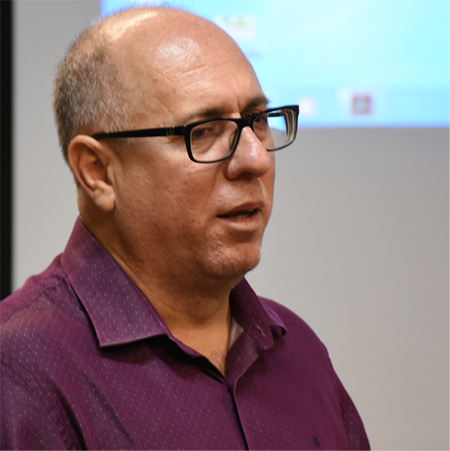
Ph.D. in Natural Sciences from the Technical University of Berlin and the Fritz-Haber Institute of the Max-Planck Society, Berlin, Germany (2002). After 11 years abroad as a Ph.D candidate, Post doctorate in Germany, and Research Associate in the United States, Dr. Da Silva returned to Brazil as Young Researcher in the Institute of Physics of São Carlos.
To date, he is an Assistant Professor at the University of São Paulo, Institute of Chemistry of São Carlos, and CNPq researcher-level 1C. He founded the QTnano group that is dedicated to the computational science of materials and chemistry using methods based on Density Functional Theory.
He has been a member of the Executive Committee of the Center for Innovation in New Energies, which is financed by FAPESP and Shell Petróleo Brasil Ltda.

Instituto de Química de São Carlos
Universidade de São Paulo, Campus São Carlos
Av. Trab. São Carlense, 400 - Parque Arnold Schimidt
13566-590 - São Carlos - SP
 qtnano@iqsc.usp.br
 qtnano.iqsc.usp.br
Instituto de Química de São Carlos
Universidade de São Paulo, Campus São Carlos
Av. Trab. São Carlense, 400 - Parque Arnold Schimidt
13566-590 - São Carlos - SP
 (xx) 98765-4321
qtnano@iqsc.usp.br
qtnano.iqsc.usp.br
(xx) 98765-4321
qtnano@iqsc.usp.br
qtnano.iqsc.usp.br
 @qtnano